BUSINESS ACCOUNTS
Maritime Walking and Working Surfaces Online Training
Online Training Certification Course
29 CFR 1915 Subpart E
From the highest rated and most trusted online training company since 2008.
This course is offered in partnership with Hard Hat Training, a 360training® company.
Slips, trips, and falls from both walking and working surfaces on vessels are among the leading causes of severe injuries and even deaths in shipyards. It is the duty of shipyard employers to ensure that their employees are trained on fall hazards and aware of how to properly mitigate these hazards.
By following the health and safety regulations regarding the walking and working surfaces of vessels set forth by OSHA, you will be able to significantly decrease the chance of sustaining injuries when performing ship breaking, shipbuilding, and ship repairing activities. By the end of this course, you will be able to recognize the dangers of walking and working surfaces and properly mitigate them to perpetuate a safe and healthy work environment.
This course is in partnership with Hard Hat Training. Hard Hat Training and Compliance Training Online™ are divisions of the 360training.
This course is designed for shipyard workers, supervisors, and safety personnel involved in shipbuilding, shipbreaking, or ship repair. It’s especially valuable for those working on or around vessel surfaces, docks, and elevated workspaces where slips, trips, and falls are common hazards.
This course is designed for shipyard workers, supervisors, and safety personnel involved in shipbuilding, shipbreaking, or ship repair. It’s especially valuable for those working on or around vessel surfaces, docks, and elevated workspaces where slips, trips, and falls are common hazards.
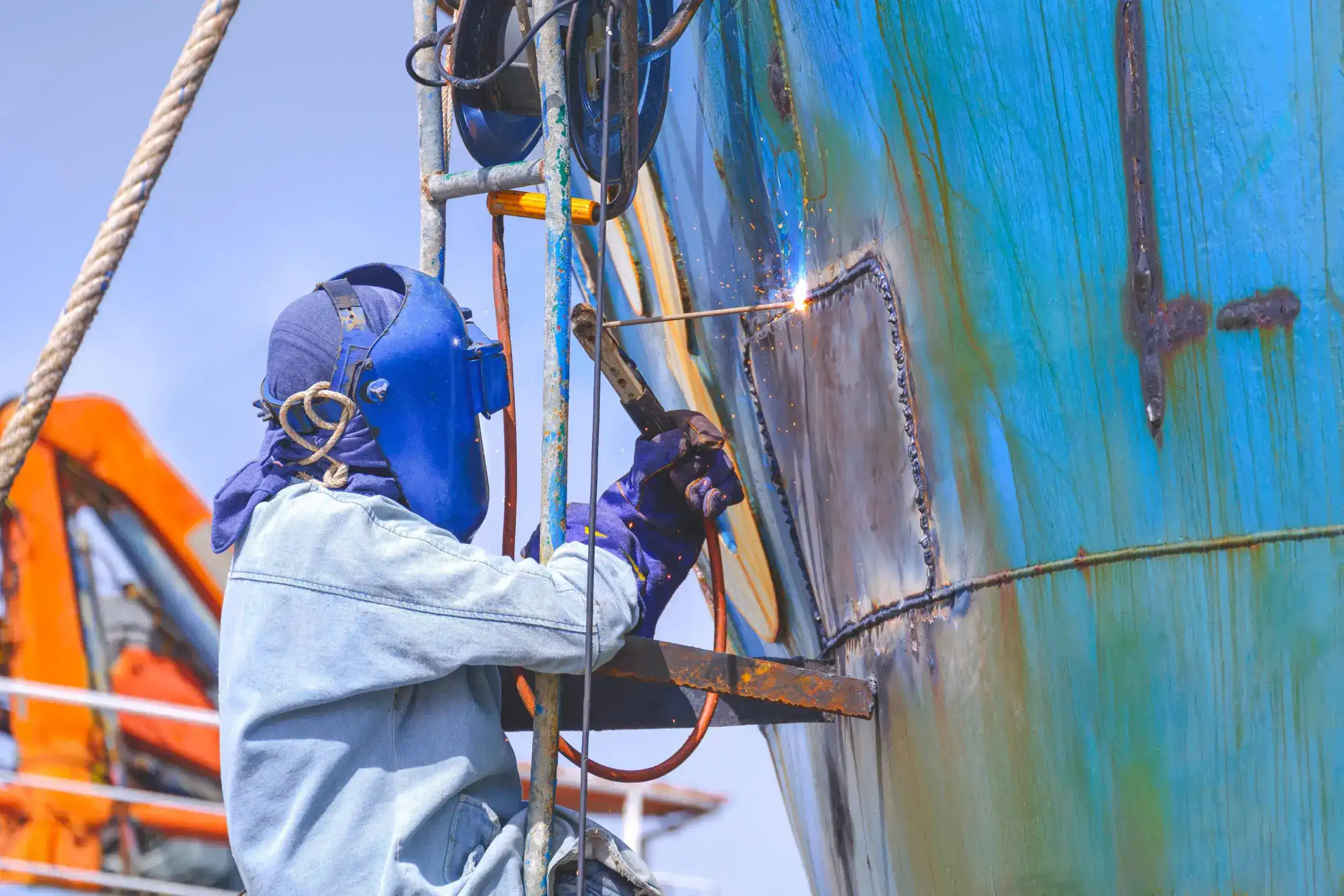
Case Study: In December 2021, a shipyard worker was attempting to set up air and electric hoses before starting welding activities on a ship. The worker then decided to remove the hoses and place them in another work area. To do so, he needed to exit the manhole he was in and move onto a scaffold on the vessel. The scaffold he moved onto was missing planks and tagged as "out of service." The worker did not realize that the scaffold was out of service and stepped onto the scaffold. He fell through the missing planks onto the walking surface of the ship. He sustained major injuries and was then hospitalized.
Key Takeaway: In this scenario, the proper maintenance of scaffolds was not practiced by the ship's crew. OSHA regulations state that all scaffolds on vessels must be maintained in a safe and secure condition. Any component of the scaffold that is broken, burned, or otherwise defective must be replaced. It was against OSHA regulations to simply mark the scaffolding as "out of service." Instead, the ship's maintenance crew should have immediately replaced the broken scaffold to prevent injury to workers.

Governing Regulations
Walking and working surfaces in the maritime industry are regulated to prevent falls, ensure safe access, and reduce hazards associated with scaffolds, ladders, and other elevated workspaces. These rules are essential for maintaining a safe environment aboard vessels, in dry docks, and throughout shipyard operations.
The relevant standards are established by the Occupational Safety and Health Administration (OSHA) and are outlined in the Code of Federal Regulations (CFR), specifically under shipyard employment regulations.
Key governing regulations include:
- OSHA 29 CFR 1915 – Shipyards
- 29 CFR 1915.73 – Guarding of Deck Openings and Edges
- 29 CFR 1915.81 – Housekeeping
- OSHA 29 CFR 1917 – Marine Terminals
- 29 CFR 1917.11 – Housekeeping
- 29 CFR 1917.12 – Slippery Conditions
- 29 CFR 1917.112 – Guarding of Edges
- OSHA 29 CFR 1918 – Longshoring
- 29 CFR 1918.91 – Housekeeping
- 29 CFR 1918.43 – Handling hatch beams and covers 29 CFR §1915 Subpart E – Scaffolds, Ladders, and Other Working Surfaces
What You'll Learn
Topics Covered
- Cabin surfaces
- Deck surfaces
- Dock surfaces
- Preventing slips, trips, and falls
Learning Objectives
By the end of this course, you will be able to:
- Recognize hazards associated with walking and working surfaces onboard a ship and on the dock
- Understand how to prevent slips, trips, and falls
- Know how to maintain a safe work environment
Most of our courses take about two (2) hours to complete. If a final exam is included, you should plan for an additional 30 minutes. Courses that require additional training time will clearly state that in the course title or description.
You’ll have unlimited access during your enrollment or access period. Most CTO courses must be completed within 90 days of purchase. OSHA-authorized Outreach Training provides up to 180 days to finish the course and required survey. Timeframes vary depending on the specific course and regulatory requirements. Please refer to our Terms & Conditions for more details.
Because our courses are self-paced, you can log in and out as needed and complete your training on a schedule that works best for you.
Retraining is required when: (1) supervision and inspections indicate that the employee is not following safety-related work practices; (2) new technology, new types of equipment, or changes in procedures necessitate the use of safety-related work practices that are different from those the employee would normally use; or (3) the employee must use safety procedures that are not normally used in his or her regular job duties. OSHA considers tasks that an employee performs less often than once a year as triggering the requirement for retraining.
Chemical Hazards & Toxic Substances (Shipyard)
This online course presents an overview of chemical hazards and toxic substances that are commonly used in the maritime and shipyard industry. The course will cover...

Hot Work (Shipyard)
This online course presents an overview of safe work practices when performing hot work in a shipyard/maritime environment. The course will cover the responsibilities of both employers...
General & Maritime Silica Safety
This course is designed to assist employers and employees in understanding the standards set forth in 29CFR1910 which covers the steps to working safely where exposure...